Hempcrete homes, from the ground up.
Hemp-lime is one of the very few mainstream-adjacent building materials that removes carbon from the atmosphere instead of adding to it. Here is how it works, what it costs, and who in California can build one for you.
What hempcrete actually is
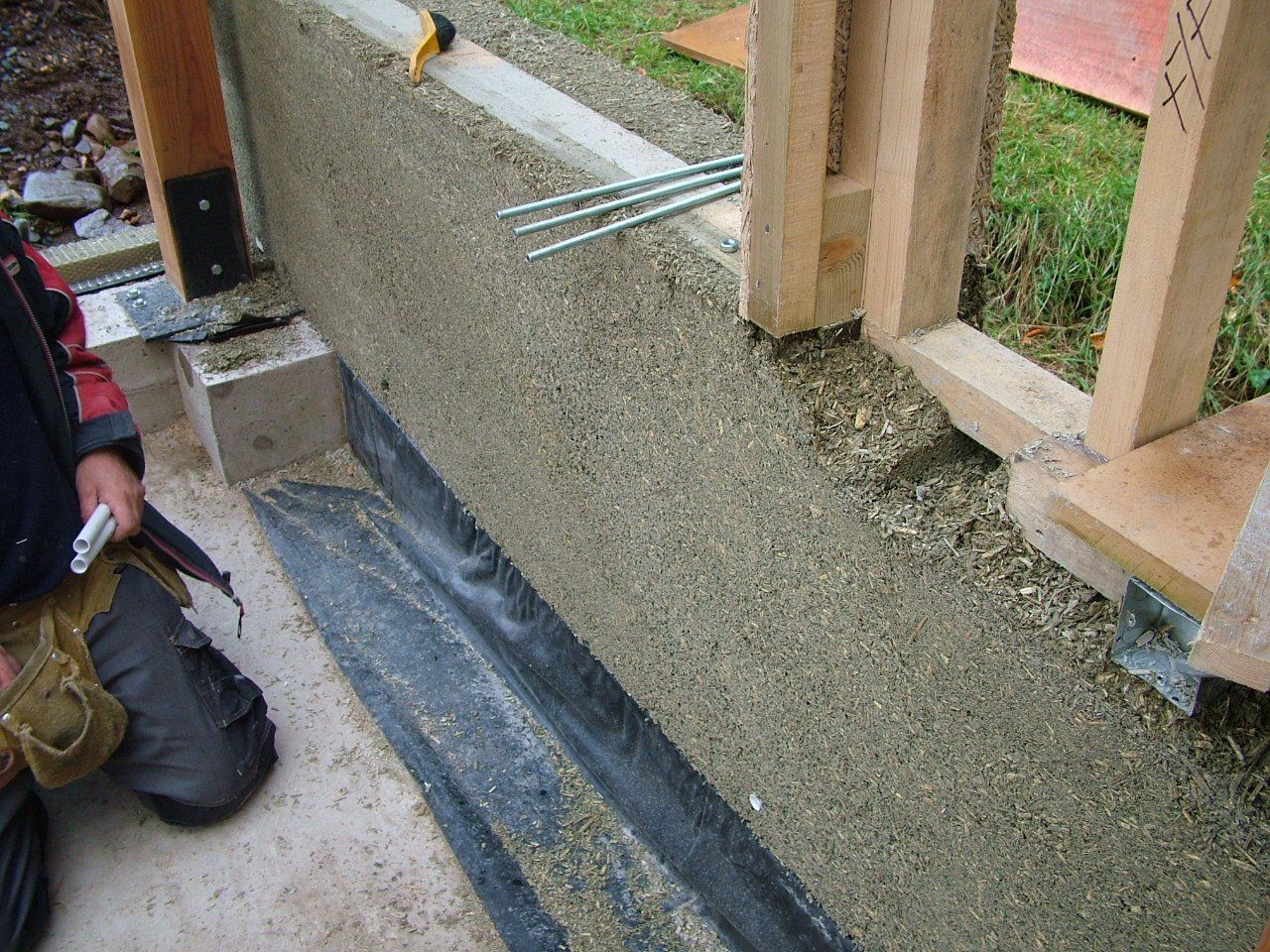
Hempcrete is a biocomposite of three things: the woody inner core of the hemp plant (called hurd or shiv), a lime-based binder, and water. Mixed together and cast around a timber or steel frame, it sets into a solid, insulating wall that is roughly one-seventh the weight of concrete.
It is not a structural material in the way concrete is. The frame carries the load; the hempcrete forms the envelope, insulation and internal finish in a single operation. That is a genuine simplification — a conventional wall is a frame, then cavity insulation, then sheathing, then a vapour barrier, then cladding.
The carbon point in one line: the hemp plant absorbed CO₂ while it grew, the lime binder re-absorbs CO₂ as it cures, and the finished wall keeps roughly 110 kg of CO₂ equivalent locked away in every cubic metre — for centuries.
Three ways it gets built
- Cast in place. Hempcrete is mixed on site and tamped into formwork around the frame. The most common route for self-builds and small contractors.
- Sprayed. A specialised spray rig applies hempcrete onto a carrier board or into a cavity. Much faster on larger walls and commercial projects.
- Precast panels. Factory-cast panels arrive by truck and are craned into position. Best fit for a conventional construction schedule.
How much carbon would a hempcrete home store?
Move the sliders. This is a transparent, order-of-magnitude model you can check the arithmetic on — not a certified life-cycle assessment.
Method: wall area is estimated at 2.6 × floor area to account for internal partitions. A finished, cured wall stores about 110 kg CO₂e per m³ of hempcrete, and one hectare of hemp yields roughly 10 tonnes of usable hurd in a season. A typical passenger car emits about 4.6 tonnes CO₂e per year. Values are illustrative — a real project should commission a material-level assessment from its supplier.
How a hempcrete project actually runs
Hempcrete is not exotic, but it is unfamiliar to most building departments — so the process matters as much as the material.
Feasibility & cost modelling
Confirm your site, climate zone and budget suit a hemp-lime envelope, and model the wall assembly and thickness for your climate.
Design & engineering
An architect and structural engineer detail the frame, the hempcrete infill and seismic connections. This is where California projects get specific.
Permits & code path
Usually an alternative-materials or engineered-design route with test data and engineering letters attached. Expect questions the first time your jurisdiction sees it.
Materials & mix design
Source hurd and lime binder, agree the mix ratio and get the binder and hurd to site as one deliverable, not two.
Formwork & casting
Hempcrete is placed in lifts and tamped, or sprayed. A crew of three to five can place a typical house wall in days, not months.
Curing, render & finish
Walls dry over several weeks, then take a breathable lime render or plaster inside and out. Get the finish wrong and you trap moisture — get it right and the wall lasts centuries.
Hempcrete cost, honestly
Hempcrete is usually a modest premium over a conventional build in materials, and a meaningful one in familiarity. The trade-off is that you delete insulation, sheathing and cladding from the wall — and own a low-energy building for a century.
| Cost component | Indicative range | What drives it |
|---|---|---|
| Hempcrete wall supply & install | $45–$95 / m² of wall | Cast vs sprayed vs precast; crew experience; wall thickness |
| Hemp hurd | $180–$450 / tonne | Distance from the decortication plant; bagged vs bulk |
| Lime binder | $450–$900 / tonne | Natural hydraulic lime grade; imported vs domestic |
| Lime render / plaster finish | $60–$140 / m² | Number of coats; hand vs sprayed finish |
| Design, engineering & permit support | $8,000–$30,000 | Whether your team has done hempcrete before |
| Whole-house premium vs conventional | Roughly 5–15% | Shrinks sharply with a second or third project in the same region |
Illustrative US ranges compiled for this demo. Always get project-specific quotes — and ask any supplier what is included in "install".
Hempcrete builders, architects & suppliers — California
Filter the network by role. Featured and premium rows are paid placements; free listings rank below them. We do not sell editorial, and we flag anything that is not yet verified.
Loading partners…
Tell us about your project, get matched with builders
Describe what you want to build and we will route it to two or three hempcrete partners who work in your area and can handle your project type. Owners pay nothing — partners pay a referral fee only when they take the lead.
What happens next
- We review your project and confirm it is a fit for hempcrete.
- You get introductions to matched partners, usually within two business days.
- You choose who to talk to. There is no obligation and no cost to you.
Your details are shared only with the matched partners you agree to. Read our privacy note.
Hempcrete FAQ
Can you even get hempcrete approved in California?
Yes, but it usually goes through an alternative-materials or engineered-design path rather than a prescriptive code table. Practically that means your team submits material test data, engineering calculations and detailing to the building department. Teams who have done it before know which documents to bring — which is why local, repeat experience matters far more than it does for a conventional build.
Does hempcrete work in a hot, dry climate like Southern California?
Its humidity buffering matters less in arid regions, but the thermal mass and breathability are still useful, and the wildfire question is where it earns its place — a mineral-lime wall does not burn and does not spread flame the way a timber or foam assembly can. Detailing changes with climate zone, so work with a designer who has specified it in yours.
Is hempcrete a load-bearing material?
In some low-rise applications it can carry load, but the widely used approach in North America is a timber, steel or concrete frame carrying the structure, with hempcrete as the infill envelope. That keeps your engineer on familiar ground and still delivers the carbon and insulation benefits.
How much more does a hempcrete home cost?
Budget roughly a 5–15% premium over a comparable conventional build, and less where local crews have done it before. Because the wall assembly absorbs the insulation, sheathing and part of the cladding, the headline premium overstates the true cost difference.
Will the walls stay dry and mould-free?
Hempcrete manages moisture by absorbing and releasing water vapour rather than trapping it — which is why breathable lime finishes are essential. Seal it behind a plastic vapour barrier or a cement render and you defeat the whole system. This is the single most common specification mistake.
Where does the hemp come from?
Increasingly from North America, including California's Central Valley, though domestic decortication capacity is still the bottleneck. Ask any supplier where the hurd was grown and processed — transport distance materially affects the carbon story.
Follow the hempcrete build log
Real projects, real numbers, real permission headaches. Monthly, no fluff.